
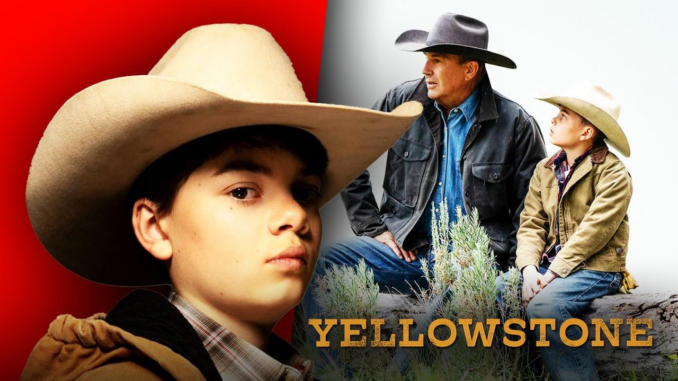
The rugged landscapes of Montana in Taylor Sheridan’s Yellowstone serve as more than just a backdrop; they are a character that demands a blood sacrifice from those who wish to own them. While the series is often defined by the political maneuvering of John Dutton and the ruthless corporate warfare led by Beth, the emotional core of the show frequently rests on the shoulders of the youngest generation. Nothing illustrates this more hauntingly than the disappearance of Tate Dutton, an event that didn’t just traumatize a child, but effectively broke the iron will of the Dutton patriarch, forcing him into a desperate alliance that changed the trajectory of the ranch forever.
Contents
The Nightmare in the High Country
The disappearance of Tate Dutton wasn’t a mere accident of wandering too far from the porch. It was a calculated, surgical strike by the Beck brothers—antagonists who understood that to hurt John Dutton, you don’t aim for his cattle or his land first; you aim for his legacy. When Tate was snatched from the ranch under the cover of darkness, the atmosphere of the show shifted from a neo-western power struggle to a visceral, high-stakes thriller.
For Kayce and Monica, the disappearance represented the ultimate failure of the ranch’s promise of safety. For John, it was a reckoning. The terrifying search through the wilderness and the subsequent discovery of where Tate was being held—a white supremacist stronghold—exposed the raw vulnerability hidden beneath the Duttons’ cowboy exterior. The image of Kayce Dutton, a man trained in the dark arts of war, hunting for his son provided some of the most intense television in recent years. However, the true tension lay in the realization that even the vast resources of the Yellowstone ranch and the legal immunity of the Livestock Commission weren’t enough to bring the boy back.
The Cost of a Grandfather’s Love
John Dutton is a man defined by his rigidity. He views compromise as a form of slow death. Yet, the kidnapping of Tate acted as the one “reset button” for his morality. The search was not just a physical trek through the brush; it was a psychological journey that forced John to look into the abyss. When the traditional methods of intimidation and local law enforcement failed to produce immediate results, John was forced to do the unthinkable: make a deal with his enemies.
To secure the intel and the tactical support needed to raid the compound where Tate was being held, John had to bridge gaps he had spent years widening. This moment in the narrative highlights a recurring theme in Yellowstone: the ranch is a black hole that consumes everything around it, but for Tate, John was willing to let the ranch itself burn. The deal-making process showcased a softer, albeit still dangerous, side of John. It proved that while he loves the land, he loves the bloodline more.
A Trauma That Reshapes the Ranch
The rescue of Tate was not the end of the story, but rather the beginning of a much darker chapter for the family. The boy who returned was not the same one who was taken. The psychological scars left on Tate—and the secondary trauma inflicted on Monica—created a rift in the family that no amount of land could bridge. Monica’s resentment toward the Dutton name reached a boiling point, realizing that her son was a pawn in a game he never asked to play.
Furthermore, the “deal” John had to strike to ensure the Becks were neutralized and Tate was recovered set a precedent for future seasons. It showed the world—and the viewers—that John Dutton’s armor had a chink. If you want to move the immovable object that is the Yellowstone ranch, you don’t go through the courts; you go through the heart.
Why This Arc Defines the Series
The terrifying search for Tate Dutton remains a fan-favorite storyline because it elevates the stakes from financial to existential. It forced the characters to stop playing “cowboys and Indians” or “landowners and developers” and start acting like human beings facing an absolute nightmare.
The brilliance of the writing in this arc lies in how it uses a child’s disappearance to strip away the vanity of the Dutton empire. In the end, the search for Tate proved that the most dangerous thing in Montana isn’t a grizzly bear or a mountain lion—it is a grandfather with nothing left to lose and a father who will tear the world apart to find his son. This pivot point in the series solidified Yellowstone as more than just a soap opera on horseback; it became a Greek tragedy set against the Big Sky.