
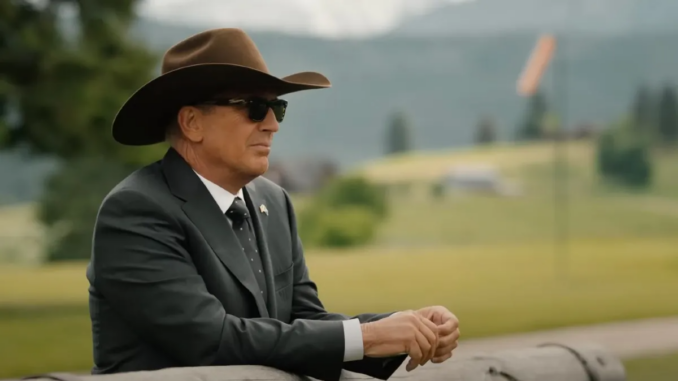
The vast, untamed wilderness of Montana serves as more than just a backdrop for Taylor Sheridan’s neo-western epic; it is a character in its own right, demanding a blood sacrifice from those who wish to claim it. At the heart of this struggle is Yellowstone, a sweeping narrative that transcends the tropes of cowboys and outlaws to explore the corrosive nature of legacy. The central figure, John Dutton, portrayed with a weathered gravitas by Kevin Costner, finds himself at a crossroads where the very actions required to save his empire are the ones most likely to destroy the soul of his family. The cost of power has never been higher, and as the series progresses, it becomes clear that John is facing a choice that could break everything he has spent a lifetime building.
To understand the weight of John Dutton’s dilemma, one must understand the land itself. The Yellowstone Dutton Ranch is the largest contiguous ranch in the United States, a massive expanse of territory that represents a vanishing way of life. For John, the ranch is not just real estate; it is a promise made to ancestors and a heritage he is duty-bound to protect. However, this commitment has turned into an obsession that blinds him to the shifting world around him. He is a man out of time, fighting a multi-front war against land developers who want to build ski resorts, the neighboring Broken Rock Reservation seeking to reclaim ancestral lands, and the encroaching influence of modern politics.
The tragedy of the Dutton family lies in the fact that John has raised his children to be soldiers rather than heirs. Beth, Kayce, and Jamie are all extensions of his will, each scarred in unique ways by the demands of the ranch. Beth, with her razor-sharp intellect and self-destructive loyalty, has become a weapon of corporate warfare. Kayce, caught between his love for his indigenous family and his duty to his father, represents the moral flickering of the ranch’s future. Jamie, perhaps the most tragic figure, seeks the validation his father refuses to give, leading to a rift that threatens to burn the entire house down. By prioritizing the land over the emotional well-being of his children, John has inadvertently ensured that there might be no one left to inherit the kingdom once the dust settles.
As the series moves into its later stages, the pressures on John shift from the physical to the political. His reluctant ascension to the office of Governor of Montana is a desperate move to use the law as a shield for his private interests. This transition highlights the ultimate paradox of his character: to protect his ranch from the outside world, he must become a part of the very system he despises. This choice forces him into a moral gray area where the line between preservation and corruption vanishes. He is no longer just defending his borders; he is manipulating the machinery of the state to serve his personal legacy, a move that invites a level of scrutiny and danger that even the Duttons may not survive.
The narrative tension of Yellowstone is built on the realization that the world is changing, but John Dutton refuses to change with it. His “choice” is effectively a refusal to compromise. He views any concession as a defeat, yet his rigidity is what creates the fractures within his inner circle. The series masterfully portrays how power, when held too tightly, becomes a crushing weight. The violence that erupts throughout the show is often a direct result of this refusal to bend. Whether it is a literal shootout or a boardroom betrayal, the stakes are always existential.
Ultimately, the story of Yellowstone is a cautionary tale about the price of holding onto the past. John Dutton’s face-off against modernity is a losing battle, not because he lacks the strength to fight, but because the cost of winning is the destruction of his family’s humanity. He faces a choice between the land and the people on it. If he saves the ranch by sacrificing his children’s peace and the state’s integrity, he is left with a hollow victory—vast acreage with no heart.
The brilliance of the show lies in making the audience root for a man whose methods are often indefensible. We see the beauty of the valley and the nobility of the ranching tradition, and we want it to survive. But as John Dutton stands on his porch, looking out over his domain, we are forced to ask if any piece of earth is worth the wreckage he leaves in his wake. The choice he faces is the ultimate test of his character, and the fallout will likely be the breaking point for everything he loves.