
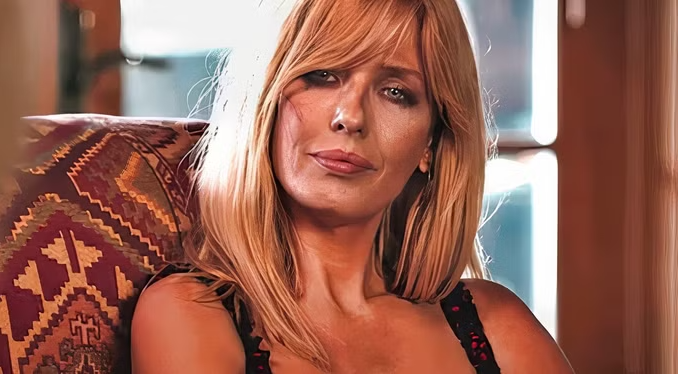
The character of Beth Dutton in Taylor Sheridan’s Yellowstone is often perceived as a hurricane in a designer suit, a force of nature fueled by whiskey and an almost supernatural level of spite. To the casual observer or the enemies of the Dutton family, she is a corporate executioner who uses her intellect and vitriol to dismantle anyone standing in the way of her father’s legacy. However, a deeper look into the narrative reveals that her ferocity is not merely a personality trait; it is a defensive shell forged in the fires of a traumatic past. In the complex ecosystem of the Yellowstone ranch, it becomes clear that not all wounds heal, and Beth carries a burden that far exceeds simple anger.
Beth’s journey is defined by a series of psychological scars that have never truly closed. The most foundational of these is the death of her mother, Evelyn Dutton. The tragedy was not just the loss itself, but the horrific circumstances surrounding it and the cruel words Evelyn spoke to her daughter in her final moments. By blaming Beth for the riding accident, Evelyn effectively cursed her daughter with a lifetime of guilt. This moment transformed Beth from a young girl into a soldier who believes she is unworthy of love yet obligated to provide total protection to her father, John Dutton. Her loyalty to John is not just familial; it is a penance she pays every day for a sin she didn’t actually commit.
However, the wound that truly dictates Beth’s volatile nature is the betrayal she suffered at the hands of her brother, Jamie. The revelation that Jamie took her to a clinic that performed a forced hysterectomy when she was a teenager is the emotional epicenter of the show’s conflict. This act did more than just rob Beth of her ability to have children; it stripped away her agency and her future. It created a void that no amount of professional success or romantic stability with Rip Wheeler can ever fully fill. This is why her hatred for Jamie is so visceral and unrelenting. It isn’t just about a mistake he made; it is about the fact that he permanently altered the trajectory of her life without her consent.
This permanent injury explains why Beth moves through the world with such desperate intensity. She operates on the principle that if she can’t be whole, she can at least be powerful. Her brilliance in the boardroom and her willingness to use “scorched earth” tactics are manifestations of a person who has nothing left to lose. When she fights for the ranch, she isn’t just fighting for land; she is fighting for the only thing that gives her life a sense of continuity. If the ranch falls, then all the sacrifices she made—and all the pain she endured—become meaningless.
Interestingly, the only person who sees past the armor is Rip Wheeler. Their relationship is one of the most compelling aspects of the series because it is a union of two broken people who have found a way to fit their jagged edges together. With Rip, Beth allows herself brief moments of vulnerability, revealing a woman who is exhausted by the weight of her own armor. Yet, even in these moments of peace, the ghosts of her past remain. Her inability to give Rip a biological child is a source of silent agony, a reminder that the wounds of the past are still bleeding into her present.
The tragedy of Beth Dutton is that her greatest strength—her resilience—is also her greatest curse. She has survived everything the world has thrown at her, but she has done so by hardening her heart to the point of brittleness. She represents the high cost of the Dutton legacy, serving as a living reminder that the land demands more than just sweat and blood; it demands the very essence of those who protect it. While John Dutton faces political and physical threats, Beth fights a war within herself every single day.
As the series progresses, it becomes evident that Beth is not looking for healing, because she doesn’t believe healing is possible for someone like her. She is looking for justice, or perhaps just a way to ensure that those who hurt her feel a fraction of the coldness she carries in her soul. Her story is a powerful exploration of how trauma, when left unaddressed and weaponized, can create a person who is both magnificent and terrifying. Beth Dutton is the heartbeat of Yellowstone, proving that while time may pass, some wounds stay as fresh as the day they were inflicted.