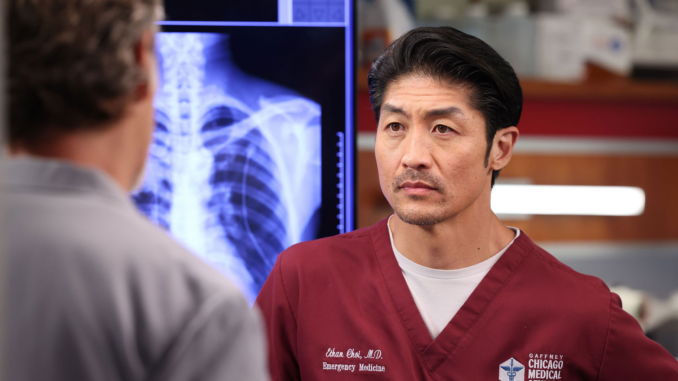
The architectural strength of the One Chicago universe has always been its ability to create heroes who feel human, flawed, and deeply committed to a code of ethics. Within the high-pressure walls of the Gaffney Chicago Medical Center, few figures have commanded as much natural authority and hard-earned respect as Dr. Ethan Choi. Played with a disciplined intensity by Brian Tee, Ethan’s journey from a rigid military veteran to a compassionate, multi-dimensional leader remains one of the most compelling arcs in medical drama history. His legacy is not just built on his surgical skill, but on a foundation of integrity that challenged both his colleagues and the audience to look closer at what it truly means to serve.
When Ethan first arrived on the scene, he was defined by his background as a United States Navy officer. This history dictated his every move, instilling a level of discipline that often clashed with the more fluid, emotional environment of a civilian emergency room. In the early seasons, Ethan was the doctor who followed the manual to the letter, believing that order and protocol were the only ways to prevent chaos. While this sometimes made him appear cold or inflexible to his peers, it established him as the moral anchor of the department. He was the man you wanted in charge during a mass casualty event because his pulse never seemed to quicken when the stakes were at their highest.
The Evolution of a Leader
The true brilliance of Ethan Choi’s character development lay in his gradual softening without the loss of his core principles. Over several seasons, we watched as the rigid commander began to understand the gray areas of medicine. He learned that sometimes the best treatment for a patient isn’t found in a textbook but in a moment of shared humanity. This evolution was particularly evident in his complex relationship with Nurse April Sexton. Their “Stellaride-like” bond pushed Ethan to confront his own emotional barriers, forcing him to balance his duty to the hospital with the messy, unpredictable reality of love and personal sacrifice.
Respect for Ethan grew exponentially as he moved into leadership roles, eventually becoming the Chief of the ED. Unlike leaders who rule through fear or ego, Ethan led by example. He was never afraid to get his hands dirty, and he never asked his team to do something he wouldn’t do himself. His leadership style was a masterclass in accountability; he held himself to a higher standard than anyone else, which made his critiques of others feel fair rather than personal. This earn-your-stripes mentality resonated deeply with the firefighters of Chicago Fire during crossover events, as they recognized in him the same blue-collar work ethic that defines Firehouse 51.
Facing Vulnerability and Trauma
Perhaps the most significant factor in Ethan becoming a fan favorite was his struggle with PTSD and the physical toll of his profession. The show didn’t shy away from the psychological scars left by his military service, nor did it ignore the physical vulnerability he faced after being shot. Seeing a man as strong and composed as Ethan struggle with recovery made him incredibly relatable. It stripped away the “super-doctor” trope and replaced it with a man who was fighting his own internal battles while trying to save the lives of others. His resilience in the face of these challenges only added to the respect his colleagues held for him, as he proved that true strength is found in the ability to admit weakness and seek healing.
His departure from the series was a testament to his character’s growth. Rather than chasing a high-prestige promotion or a lucrative private practice role, Ethan chose to start a mobile clinic with April to serve the underprivileged communities of Chicago. This move brought his story full circle—from a man who lived by the rigid rules of a massive institution to a man who realized that the most impactful medicine happens on the streets, meeting people where they are. It was the ultimate act of service and a reflection of the selfless heart that had been beating beneath his scrubs all along.
A Lasting Legacy in One Chicago
Even after his exit, the vacuum left by Dr. Ethan Choi is palpable. He remains the benchmark for what a Chicago Med doctor should be: technically brilliant, morally unshakeable, and eternally dedicated to the city. Brian Tee’s performance ensured that Ethan was never a caricature of a soldier; instead, he was a man of deep conviction whose presence made everyone around him better. Whether he was navigating a complex surgery or mentorning a junior resident, he did so with a level of gravitas that is rare in television.
For fans of the franchise, Ethan Choi represents the ideal of the “quiet hero.” He didn’t need the loudest voice in the room to be the leader, and he didn’t need the spotlight to do the right thing. His respect was not given; it was built, brick by brick, through years of consistent, honorable service. As the doors of the ED continue to swing open for new cases and new doctors, the shadow of Dr. Choi’s integrity remains, serving as a reminder that in the world of One Chicago, character is the most important medicine of all.