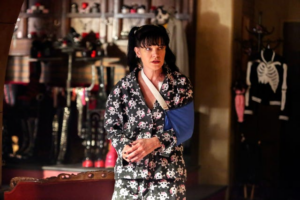
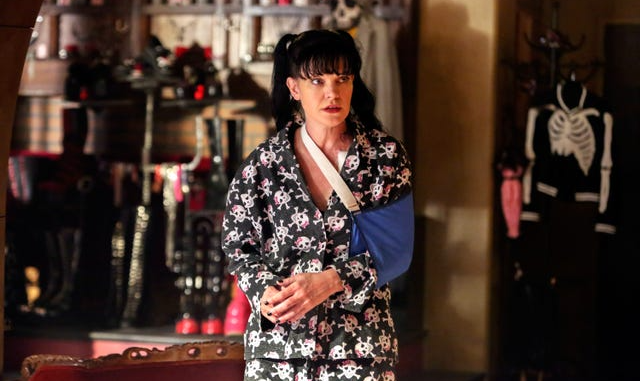
In the high-stakes, adrenaline-fueled world of the Naval Criminal Investigative Service, where the focus usually rests on forensic evidence and tactical raids, it was the eccentric, pigtail-wearing forensic scientist Abby Sciuto who provided the show’s vibrant, beating heart. For fifteen seasons, Pauley Perrette portrayed Abby not just as a brilliant mind, but as the moral and emotional compass of the team. While she had countless memorable scenes involving Caf-Pow and gothic flair, there is one specific, gut-wrenching moment that stands above the rest—the emotional peak that defined her character and left an indelible mark on the series: the death of Special Agent Clayton Reeves and Abby’s subsequent decision to leave the Bureau.
The episode “Two Steps Back” serves as the catalyst for this unforgettable moment. In a shocking turn of events, Abby and Reeves are targeted by a hitman. In a split-second act of heroism, Reeves sacrifices his life to protect Abby, taking a bullet intended for her. The sight of Abby lying in a hospital bed, physically battered but emotionally shattered, was a jarring departure from her usual bubbly, “Goth-sunshine” persona. However, the most emotional moment occurs when Abby, having survived the ordeal, visits the morgue to say her final goodbye to Reeves.
Standing over his body, the silence of the room is heavy with a grief that feels almost physical. In this moment, we see an Abby Sciuto we had never truly seen before—one stripped of her armor of music and technology. She speaks to him with a vulnerability that is devastating, promising to honor his legacy by starting a charity in London that his mother had always dreamed of. It was the moment that the reality of the job finally broke her. For years, Abby had processed the deaths of strangers and even teammates, but the weight of Reeves’ sacrifice was a burden she could no longer carry while remaining within the walls of the Navy Yard.
This scene is so unforgettable because it represents the “loss of innocence” for the show’s most optimistic character. Abby had always been the one to hug everyone, the one to believe in the best of humanity despite the horrors she saw under her microscope. Seeing her realize that she could no longer function in an environment where her friends died protecting her was a profound narrative shift. When she later confronts Gibbs—the man she viewed as a father figure—and tells him through tears that she has to go, it felt like the end of an era. Their final “silent” goodbye through the window of the lab was a masterclass in subtlety, but it was the raw, unfiltered grief in the morgue that remains etched in the minds of the “NCIS” faithful.
Technically, the performance by Pauley Perrette in these final sequences was a career-high. She managed to convey a sense of “numbness” that occurs after a trauma, making her eventual breakdown feel earned and authentic. The cinematography played a key role as well; the lab, usually filled with bright lights and neon, felt colder and more hollow, reflecting Abby’s internal state. The absence of her usual heavy metal soundtrack in these scenes emphasized the gravity of her decision. It was a rare moment where the show allowed a character to simply sit with their pain without rushing to the next action sequence.
The legacy of this moment is why fans still discuss Abby in 2026. Her exit wasn’t just a career move; it was a soul-searching mission fueled by love and survivor’s guilt. By choosing to leave and fulfill Reeves’ dream, she proved that she was the ultimate “Special” Agent—one who understood that sometimes the most important work happens outside the lines of a crime scene. It was a bittersweet conclusion to a legendary run, reminding us that the strongest people are often those who are brave enough to admit when they’ve had enough.
Abby Sciuto’s most emotional moment wasn’t a forensic breakthrough; it was a quiet promise made in a morgue. It was the moment she transitioned from a scientist to a legacy-builder. For those who watched her grow over fifteen years, seeing her walk away was heartbreaking, but it was also a beautiful testament to the character’s depth. She left us with one final lesson: that in a world of darkness, the only way to survive is to carry the light for those who can no longer see it. That final, tearful goodbye is a piece of television history that we will truly never forget.