
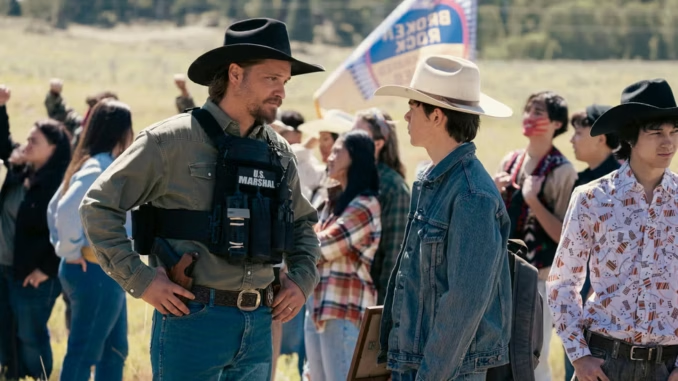
The latest Yellowstone spin-off series is the first not written by its creator. It shows.
hat new threat could possibly place a gun in Kayce Dutton’s (Luke Grimes) hands again? After selling his family’s ranch in the Yellowstone finale and putting a life of violence behind him for the sake of his wife, Monica (Kelsey Asbile), and his son Tate (Brecken Merill), Kayce would need Taylor Sheridan to write something massive for him to revert to his old ways—as if he didn’t learn anything from his namesake’s generational curse.
Marshals, the fourth Yellowstone spin-off series and the first to occur after the events of Yellowstone’s finale, provides audiences with an answer in the very first episode: Kayce’s wife is dead. As returning character Thomas Rainwater (Gil Birmingham) explains, Monica died from cancer after toxins seeped onto the reservation’s lands by means of “radioactive colonialism.” Kayce, an aimless and grieving widower who spends his days sulking on his ranch, is now desperate for a way forward.
Sending your character on a dark path of violence at the expense of their wife’s life is nothing new. It’s how audiences got John Wick, Mad Max, and hundreds of angry male literary heroes on a quest for revenge. You know the type: tortured yet badass characters who were just waiting for a reason to kill … had they not been soothed by the calming presence of their significant other.
So just like John Wick after you steal his car and kill his dog, Kayce’s trigger finger is restored. The weird bit, however, is that Monica died from cancer. Maybe, if Kayce was looking to join the US Marshals’ investigation into bringing his wife’s killer to justice, then it would be a different story. But that’s not what the team went with here. So Kayce needs a different reason. And if Marshals had an ounce more of Taylor Sheridan’s magic in it, we might have eventually gotten there.
Instead, Kayce’s story in Marshals is carried on by someone other than Sheridan for the first time in Yellowstone’s history. Showrunner Spencer Hudnut’s most recent project was Paramount’s SEAL Team (2017), and it’s clear that crime procedurals are where his strengths ultimately lie. But Yellowstone, a drama series that sought to produce something wholly different from what the traditional TV landscape already delivered, was—to put it frankly—a world away from all that bullshit.
In Sheridan’s original series, the most respected authority in the land was Livestock Commissioner. Anything higher than that and you were a crooked nuisance, treading on the American dream. Yellowstone painted Montana as a world where the Duttons are the last protectors of a pure, untouched paradise. It wasn’t as straightforward as good guys and bad guys. John Dutton branded his followers with the ranch’s Y, and each character was as deeply flawed as they were a champion of their own ideals.
So when US Marshal Pete Calvin (Logan Marshall-Green) drives up to Kayce’s door and declares that Montana is falling to the influence of “gangs, cartels, and race warriors,” you couldn’t design a rougher transition from Yellowstone to Marshals. These nameless new threats are dangerous, sure, but what do they have to do with Kayce? What do they have to do with Yellowstone?
In all fairness, Kayce always came from a different world than the rest of his family. He was a former Navy SEAL and—by extension of his marriage to Monica—a bridge between the Duttons and the Broken Rock Reservation. He never really understood his family’s violent history, even when he was actively participating in it. That’s why it was Kayce who eventually linked the two worlds in the finale and sold his father’s land back to the reservation. He was the only Dutton who could end the cycle of violence. He was the one character who could end Yellowstone in a place that felt right.
But Marshals—and Paramount—had other plans for Kayce. Now violence continues to find him, mostly because he’s restless without Monica in his life. And now that Marshals has set up Montana as some supposed hotbed of criminal activity, his sense of duty returns. “You always told me to fight for the life I want, but I had the life I wanted with you,” Kayce tells his wife’s grave. “I’m changing paths, to try and find a new beginning for me and Tate.” If violence follows the Duttons like a curse, then Kayce might as well help direct that energy somewhere useful, I guess.
It’s a simple conceptual journey to sell, but Marshals doesn’t really reach this conclusion from what we’ve seen so far in the premiere. It might have been possible had Sheridan been there to weave viewers through one of his patented extended metaphors. Sadly, he’s not here to usher us into the sequel.
Kayce’s life is now a kind of TV show that you’ve seen countless times before. It doesn’t have the same artfulness behind it, and the pacing barely leaves time for sweeping shots of the Montana valley or reflection of any kind. As US Marshal newcomer Miles Kittle (Tatanka Means) simply states, he “signed up to crush skulls.” And when Kayce saves the day by killing his first criminal, he tells Thomas Rainwater that it was “nice to kill for someone rather than something.”
Kayce’s selfless attitude might make things easier on the procedural writing team behind Marshals—and the viewers who are less familiar with the something that the Duttons were fighting for before. The first episode operates instead on the logic that there’s really no time to think about why you’re fighting when the devil comes knocking. I’m just not certain yet that it makes for a worthy continuation of Yellowstone’s legacy.