
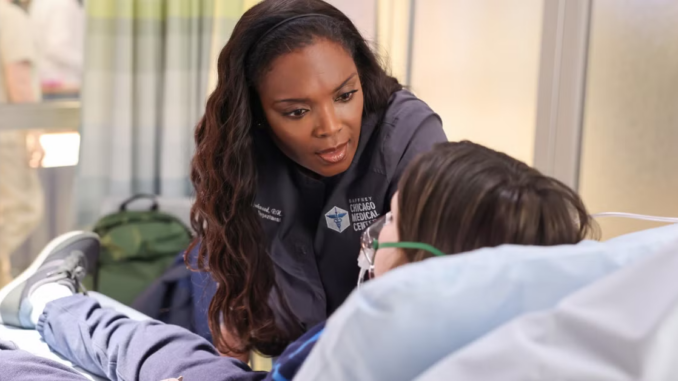
The high-pressure environment of the Gaffney Chicago Medical Center emergency department is a place where seconds define the boundary between life and death. In the world of Chicago Med, no character embodies the resilience and clinical precision of this environment more than Maggie Lockwood. As the charge nurse, she is the engine of the ED, the one who keeps the chaos organized and ensures that every patient receives a fighting chance. However, even the most seasoned veterans are susceptible to the crushing weight of human error, and a recent turn of events has left fans reeling from what is being called Maggie’s fatal mistake. It was a heartbreaking choice made in the heat of a crisis, one that serves as a grim reminder that in medicine, even a decision made with the best intentions can lead to a devastating loss of life.
The tragedy began during a massive influx of trauma patients following a multi-vehicle accident. The ED was operating at maximum capacity, with resources stretched to their absolute limits. Amidst this frenzy, Maggie was forced to make a split-second triage decision. Triage is the most brutal part of the job; it requires a provider to play God, deciding who gets the immediate attention of a surgeon and who must wait. When two patients arrived simultaneously—one a young man with a visible but seemingly stable chest wound and the other an elderly woman in respiratory distress—Maggie relied on her years of instinct. She directed the primary surgical team to the elderly woman, believing the young man could hold on for ten more minutes until the next team was free.
However, the visible stability of the young man was a mask for a catastrophic internal injury. He was suffering from a silent, rapidly progressing tension pneumothorax that went unnoticed because the monitors were already occupied by other victims. By the time Maggie circled back to check his vitals, his heart had stopped. Despite a frantic, heroic effort to open his chest right there in the treatment bay, the damage was irreversible. The young man was pronounced dead, leaving a vacuum of silence in the middle of the noisy hospital. The realization hit Maggie like a physical blow: her assessment had been wrong, and that error in judgment had cost a life that might have been saved.
What makes this mistake so heartbreaking for the audience is the context of Maggie’s character. She isn’t just a nurse; she is the moral compass of the unit. We have seen her go to prison to protect a friend and battle cancer while never missing a shift. Watching someone so competent crumble under the weight of guilt is a testament to the show’s ability to humanize its heroes. The aftermath of the incident saw Maggie retreating into a shell of professional coldness, a defense mechanism against the haunting “what ifs” that plague every healthcare worker after a bad outcome. She began to question every minor protocol, stalling the flow of the ED because she no longer trusted the very instincts that had made her a legend in the hospital.
The fallout extended beyond Maggie herself, creating a ripple effect across the entire One Chicago universe. Dr. Will Halstead and Sharon Goodwin found themselves in the difficult position of having to conduct a formal review of the incident. While the hospital administration looked at the numbers and the lack of available staff, Maggie could only see the face of the young man’s mother when she was delivered the news. The legalities of a medical error are one thing, but the spiritual and emotional cost is another entirely. This storyline highlights the systemic failures of an overworked healthcare system where perfection is expected but rarely supported by adequate staffing levels.
As the season progresses, this fatal mistake is likely to redefine Maggie’s role at Med. It forces a conversation about burnout and the unrealistic expectations placed on frontline workers. Is it fair to blame a single person for a death that occurred during a city-wide disaster? Or is the mistake a sign that Maggie has reached her breaking point? The tension between her clinical duty and her personal empathy has always been her greatest strength, but in this instance, it became her greatest vulnerability.
For the viewers, this plot point serves as a powerful narrative anchor. It strips away the shiny, procedural veneer of a TV drama and replaces it with the raw, uncomfortable reality of human fallibility. Chicago Med has always excelled at exploring the grey areas of ethics, and Maggie’s heartbreaking choice is the pinnacle of that exploration. It leaves us wondering if she can ever truly forgive herself, or if the ghost of that decision will follow her every time she picks up a clipboard. In the end, Maggie’s story is a tribute to the impossible burden of the medical profession, where one wrong turn on a busy afternoon can change the course of multiple lives forever.