
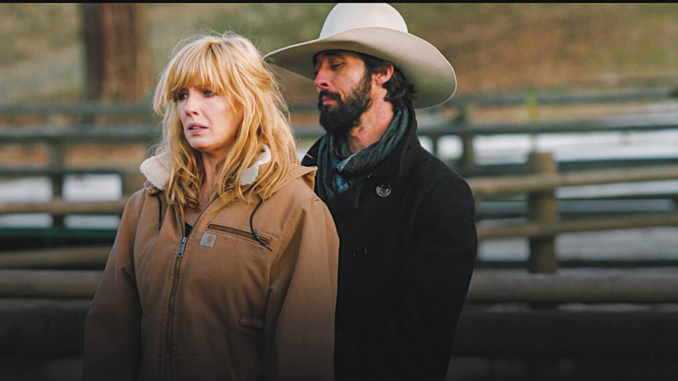
The rugged landscape of the Yellowstone Dutton Ranch is a place where survival is the only true currency and where the concept of love often takes on a sharp, jagged edge. Among the ensemble of complex characters created by Taylor Sheridan, none embodies this harsh reality more than Rip Wheeler. As the ranch foreman and the family’s most devoted enforcer, Rip is a man of few words and decisive actions. Through his unwavering loyalty to John Dutton and his volatile yet deep connection to Beth, Rip Wheeler consistently proves that in a world defined by conflict, love isn’t always gentle; sometimes, it is a shield, a weapon, and a heavy burden all at once.
Rip’s understanding of love was forged in the trauma of his youth. Having survived a horrific family tragedy and being taken in by John Dutton as a runaway, his heart was hardened by necessity long before he reached adulthood. To Rip, love is synonymous with protection and sacrifice. He does not express affection through grand gestures or soft words; instead, he shows it through the dirt under his fingernails and the blood on his knuckles. His devotion to the ranch is a form of love that requires him to do the things no one else can or will do. Whether he is branding a new hand or dealing with a threat to the family, his actions are driven by a singular, fierce commitment to the man who gave him a second chance at life.
This rough-hewn philosophy of affection is most evident in his relationship with Beth Dutton. Their romance is one of the most compelling and unconventional depictions of love on modern television. It is not a fairy tale built on shared dreams, but a partnership grounded in a shared understanding of pain. Rip is perhaps the only person who truly sees Beth for who she is, looking past her armor of vitriol and self-destruction to find the wounded woman beneath. His love for her is gentle only in its constancy, not in its execution. He allows her to be her most chaotic self, standing as a steady anchor in the middle of her storms. When Beth is at her most destructive, Rip doesn’t try to change her; he simply stands by her side, ready to catch her or help her bury the evidence of her latest war.
However, the weight of this love often demands a high price. To be Rip Wheeler is to live in a constant state of readiness for violence. He understands that protecting the people he loves means being the person they can never be. This creates a tragic isolation in his character. While he finds solace in the quiet moments on the ranch and the rare glimpses of peace with Beth, he is always aware that his utility to the Dutton family is tied to his capacity for brutality. He loves the land and the people on it so much that he is willing to lose his own soul to ensure their survival. This is the ultimate proof that his love is not a soft emotion but a lifelong sentence of duty.
In the later seasons of Yellowstone, we see Rip grapple with the shifting dynamics of the ranch and the encroaching modern world. Even as he takes on a more paternal role with figures like Carter, the orphaned boy who reminds him of his younger self, his approach remains grounded in tough love. He teaches through hardship because he knows the world will not be kind to those who are soft. He pushes those around him to be resilient, believing that strength is the only way to endure the inevitable losses that come with life in Montana. It is a harsh way to live, yet in the context of the Duttons’ struggle, it is the only way to stay standing.
The character of Rip Wheeler resonates so deeply with audiences because he represents an old-school ideal of masculinity that is both terrifying and comforting. He is the person you want in your corner when the world is ending, but he is also a reminder of the scars that come with that level of devotion. His love for Beth and the ranch is a flame that burns hot and bright, but it is a fire that can also consume. He proves time and again that true commitment is not about easy days and sweet sentiments; it is about the willingness to endure the cold and the dark for the sake of another.
Ultimately, Rip Wheeler’s story is a testament to the idea that the most profound forms of love are often the most difficult. He does not seek recognition or rewards for his service. He is content to remain in the shadows, a silent guardian of a vanishing way of life. By accepting the harshness of his existence, he becomes the bedrock upon which the Yellowstone ranch is built. His journey continues to show that while love can be a source of immense pain, it is also the only thing worth fighting for in an unforgiving world. Rip Wheeler doesn’t just protect the ranch; he embodies the spirit of a man who knows that love, in its purest form, is the hardest work there is.