
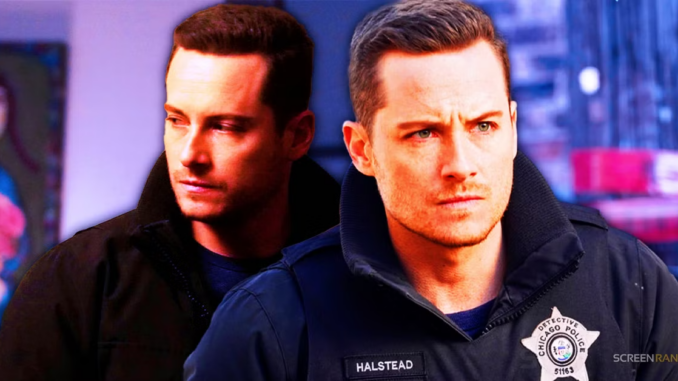
Jay Halstead’s Exit Explained: The Real Reason Behind His Sudden Departure
For a decade, Detective Jay Halstead served as the moral compass of the Intelligence Unit on Chicago P.D., providing a necessary counterbalance to the morally flexible tactics of Sergeant Hank Voight. As portrayed by Jesse Lee Soffer, Jay was the quintessential hero—principled, disciplined, and deeply committed to the city he protected. However, the early episodes of the tenth season delivered a staggering blow to the One Chicago faithful when Jay abruptly turned in his badge, said a tearful goodbye to his wife Hailey Upton, and headed to Bolivia to lead an army unit tracking down drug cartels. The suddenness of this transition left millions of viewers questioning the narrative logic and searching for the real-world motivations behind one of the most significant departures in the franchise’s history.
The on-screen explanation for Jay’s exit was rooted in a crisis of conscience. Throughout the previous seasons, Jay had found himself increasingly entangled in Voight’s world of gray areas and covered-up crimes. The breaking point arrived during a particularly grueling case where Jay realized he was losing the very version of himself he fought so hard to maintain. His decision to return to the army was framed as a desperate attempt to find a black-and-white world where the lines between good and evil were clearly defined. While this provided a dramatic thematic conclusion to his character arc, many fans felt the departure was rushed, especially considering the recent marriage between Jay and Hailey, popularly known as Upstead.
To understand the real reason behind this sudden departure, one must look toward the professional evolution of Jesse Lee Soffer. After nearly 200 episodes and ten years in the trenches of Chicago, the actor felt it was time for a new chapter. In various interviews following his exit, Soffer expressed a deep love for the character and the cast but noted that he had reached a point where he wanted to see what else was out there creatively. Stepping away from a leading role on a hit network drama is never an easy choice, but for an actor who had dedicated his entire thirties to a single persona, the desire for growth eventually outweighed the comfort of the status quo. It was a personal decision built on a decade of hard work and a need for a fresh perspective.
Furthermore, the departure was influenced by the natural lifecycle of a long-running procedural. One Chicago is a massive machine, and as shows cross the ten-year mark, they often undergo significant casting shifts to keep the dynamics fresh and the budgets manageable. While the producers and showrunners expressed their sadness at losing such a cornerstone of the series, there was also a mutual respect for Soffer’s timing. His exit allowed the writers to explore a new, darker side of Hailey Upton, forced to navigate the Intelligence Unit without her partner and husband. It injected a fresh sense of conflict into the squad room, even if it meant sacrificing the show’s most reliable moral anchor.
The impact of Jay’s absence has been profound, creating a leadership vacuum that the rest of the team is still struggling to fill. Kevin Atwater and Adam Ruzek have had to step up in ways they never expected, and Voight himself has seemed more isolated without Jay there to challenge his darker impulses. For the fans, the loss was compounded by the fact that the Halstead name has been a part of the One Chicago DNA since the very beginning. With Jay’s brother, Will Halstead, also departing Chicago Med, the era of the Halstead brothers has officially come to a close. This double loss has sparked a wave of nostalgia across the digital landscape, with fans revisiting the most iconic crossovers and brotherhood moments that defined the early years of the franchise.
From a production standpoint, Jesse Lee Soffer didn’t stay away for long, as he returned to the Chicago P.D. set shortly after his exit—this time behind the camera. His transition into directing provided a bridge for the cast and crew, proving that his departure wasn’t based on any internal friction but rather a genuine move toward the next stage of his career. This behind-the-scenes continuity helped ease the transition for the viewers, knowing that the man who brought Jay Halstead to life was still a part of the family, even if he was no longer wearing the tactical vest.
As Chicago P.D. continues to evolve, the ghost of Jay Halstead remains a permanent fixture of the narrative. Every time Hailey stares at a photo or Voight makes a questionable call, the audience is reminded of the man who always tried to do the right thing. While the “real” reason for the exit was a standard professional pivot, the emotional weight of his departure continues to drive the show’s most compelling storylines. Jay Halstead may be in Bolivia, but his influence on the streets of Chicago is a legacy that will never truly fade.