
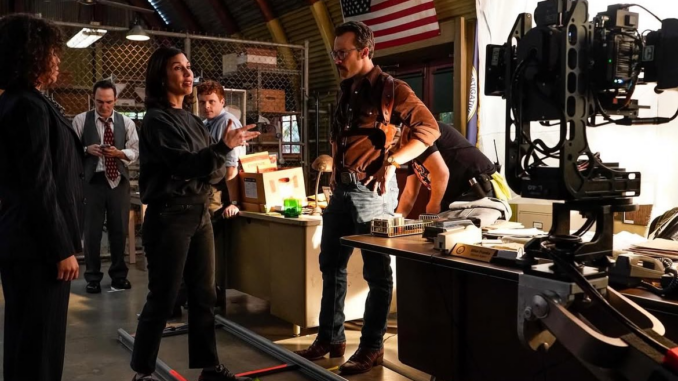
For over two decades, NCIS has stood as a titan of procedural television, maintaining a level of consistency and popularity that most shows can only dream of. To the millions of viewers tuning in every week, the Navy Yard team appears as a seamless, tight-knit family solving complex crimes with military precision. However, beneath the polished surface of the Major Case Response Team lies a history of off-camera tension, legendary feuds, and production hurdles that are just as dramatic as the scripts themselves. Understanding the evolution of the series requires looking past the crime scenes and into the high-stakes environment of the production set where creative visions and strong personalities have frequently clashed.
The most famous chapter in the show’s history of internal conflict involves the departure of the man who started it all, Mark Harmon. While his exit as Leroy Jethro Gibbs was handled with narrative grace on screen, reports of friction had circulated for years. One of the most publicized incidents involved a long-standing rift between Harmon and Pauley Perrette, who played the beloved forensic scientist Abby Sciuto. The tension allegedly escalated to the point where the two stars no longer filmed scenes together, leading to a noticeable shift in the show’s editing and story structure. When Perrette eventually left the series, her social media posts hinted at a workplace environment that was far more complicated than fans had ever imagined. This era marked a turning point for the production, forcing the crew to navigate a fractured atmosphere while keeping the show’s momentum alive.
However, the drama wasn’t limited to just two individuals. The very foundation of NCIS was built on a demanding production schedule that tested the endurance of every cast member. In the early years, the show was notorious for its grueling eighteen-hour workdays. Original cast members like Michael Weatherly and Cote de Pablo have often spoken about the physical and mental toll of maintaining such a high output. These long hours created a pressure cooker environment where minor disagreements could easily spiral into significant set-wide tension. The departure of Cote de Pablo in Season 11 was a particularly jarring moment for the fandom, and while she eventually returned for a guest arc, the initial exit was shrouded in creative differences regarding the direction of her character, Ziva David. It served as a reminder that even the most successful television partnerships are subject to the realities of contract negotiations and artistic vision.
Beyond the cast, the leadership behind the camera also saw its share of upheaval. The transition of showrunners and executive producers over twenty seasons is a natural part of any long-running series, but in the case of NCIS, these shifts often reflected deeper changes in the show’s DNA. Following the passing of original showrunner Gary Glasberg, the production had to find its footing while grieving a leader who had steered the ship through some of its most successful years. The challenge was to modernize the show for a changing television landscape without losing the core values that Gibbs had instilled. This period of transition required a delicate balance of honoring the past while ushering in new faces like Wilmer Valderrama and Katrina Law, who had to integrate into a production culture that had been established for over a decade.
Interestingly, much of the set drama has also been fueled by the show’s status as a massive global franchise. With the birth of spin-offs in Los Angeles, New Orleans, Hawaii, and Sydney, the original mothership set became the gold standard that every other production tried to emulate. This created a unique kind of pressure on the NCIS crew to remain the flagship of the brand. Every casting change or behind-the-scenes rumor was magnified by the intense scrutiny of a global audience. Yet, despite the headlines and the occasional social media firestorm, the production has shown a remarkable ability to self-correct. The current era of the show, led by Gary Cole and Sean Murray, is often described by insiders as having a much more relaxed and collaborative atmosphere compared to the high-intensity years of the past.
Ultimately, the drama behind the scenes of NCIS is a testament to the passion involved in creating a cultural phenomenon. When people spend more time with their co-stars than their own families for twenty years, friction is almost an mathematical certainty. What is truly impressive is not that there was conflict, but that the show survived it all. Each departure and each set-side disagreement became a catalyst for growth, allowing the series to shed its old skin and find new ways to connect with audiences. Today, the legacy of the NCIS set is one of resilience, proving that even when the cameras aren’t rolling, the story of this team is defined by their ability to overcome the odds.